Overview
Neuroscience
Liability
PTSD
Methodology
Safety
Procurement
Legal Defense
Supplemental
Troysgate Human Threat Response System
In the Heat of the Moment Stress Conditioning
Closing the Gap Between Training and Subconscious Survival Reactions that occur during the Heat of the Moment
1: Overview & Bottom Line Up Front (BLUF)
Core Takeaway:
Troysgate introduces a highly effective solution to a long-standing, established, and documented issue that continues to affect humans subjected to dangerous, life-threatening situations. By stabilizing the subconscious survival network, our system reduces cognitive degradation under maximum stress to help shield agencies from operational and use-of-force liabilities.
Troysgate addresses critical documented human performance crisis’s that traditional training cannot solve. Our system introduces a highly effective solution to the long-standing, life-threatening stress reactions that cause serious reactions during the Heat of the Moment.
BLUF:
Tactical environments are fast-moving, contested, and cognitively demanding. Technical firearms proficiency is an entirely separate network from subconscious survival reflexes. When an unconditioned operator transitions into a high-fear state, cognitive degradation causes tunnel vision, rapid pulse spikes, deep muscle tightening, and tactical paralysis or premature use of force.
The Troysgate System:
A neuroadaptive, patented stress inoculation architecture designed to trigger genuine physiological alarm states (adrenaline/cortisol surges) within a structurally safe environment. It forces the logical brain and the survival brain to fire in perfect synchronization, locking in accurate threat detection and disciplined execution under maximum operational pressure.
The Primary Capabilities:
- Subconscious Conditioning: Closes the performance drop between low-stress simulation and raw field combat.
- Cognitive Preservation: Calibrates the neural network to actively prevent an amygdala hijack, preserving fine motor command, analytical judgment, and tactical patience.
- Liability Reduction: Uses evidence-based inhibitory learning to neutralize panic before it drops operators into unconditioned aggression, anger, or rage.
Top of page
2: The Neuroscience
Core Takeaway:
Maps out the biological triad of the brain and explains why the amygdala only learns when it is actively turned on.
The Subconscious Performance Gap:
The brain registers and reacts to threat patterns below conscious awareness. Operators routinely recoil, freeze, or fire rounds before the prefrontal cortex can process the data.
The Triad Network Mapping:
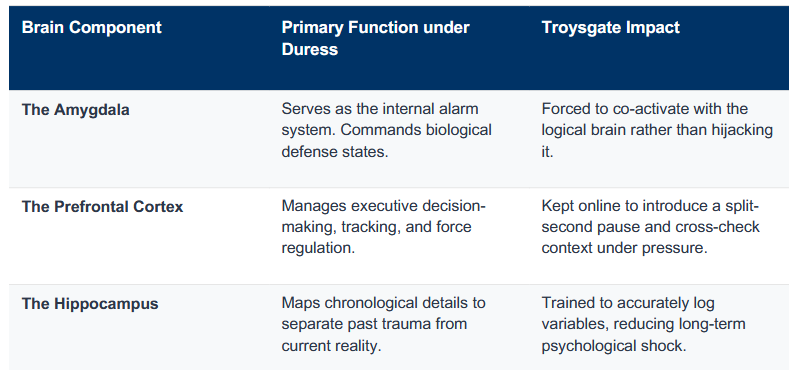
- The Amygdala: The brain's rapid internal alarm system. It detects threat patterns and commands full biological defense states. It does not record all experiences equally; its neural circuits only rewrite when it is actively engaged via high-salience experiences.
- The Prefrontal Cortex: Manages executive decision-making, contextual tracking, planning, and control. It calms overactive emotional responses and verifies input before force execution.
- The Hippocampus: Maps chronological details and spatial boundaries, allowing the brain to place specific inputs into correct context to separate past trauma from current reality.
- Synaptic Plasticity & Consolidation: The brain tracks threat signatures by altering connection strengths between neurons. When an operator undergoes high-stress exposure, the brain applies an emotional "tag" to the event. If the amygdala remains dormant during training (e.g., standard classroom settings), the brain archives it as background noise. True activation flags the experience, making the tactical lesson vivid, durable, and instantly retrievable.
Top of page
3: Liability & Risk Mitigation
Core Takeaway:
Explains how unmanaged fear rapidly degrades into professional, tactical, and legal liabilities.
The Distortion of Threat Perception:
Unconditioned fear warps operational judgment, forcing the human mind to hyper-focus on danger while blinding the operator to context, evidence, or alternative explanations. It exaggerates minor risks into immediate crises, causing the worst possible outcome to feel certain and driving disproportionate force choices.
The Downward Spectrum of Unmanaged Fear:
- Fight/Flight/Freeze/Fawn: Triggered by immediate survival threats, resulting in hyper-aggressive overreaction, sudden flight, complete immobility, or submissive fawning.
- Aggression: Driven by subconscious uncertainty or loss of area control, causing muscle tension and premature deployment of weapons systems.
- Anger: A reaction to perceived resistance or tactical vulnerability, resulting in disrupted team communications and the total collapse of tactical patience.
- Rage: Prolonged emotional flooding that overrides all composition, weakening impulse boundaries and creating a severe threat to lawful, proportional conduct.
- Revenge: An unethical, illegal, and maladaptive breakdown of institutional discipline, guided entirely by malice rather than mission standards.
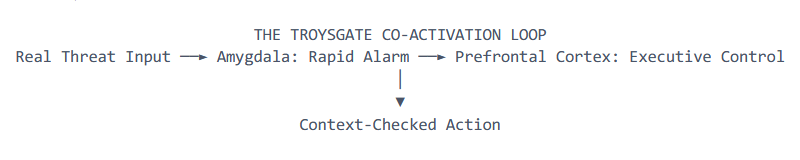
- Squeezing the Decision Gap: Troysgate conditions the brain to introduce an instantaneous cognitive pause under fire, replacing panic reflexes with split-second context checking.
Top of page
4: Operational Wellness & PTSD
Core Takeaway:
Outlines how the system provides proactive trauma inoculation and repairs embedded trauma triggers.
The Pathology of Tactical Trauma:
Chronic stress conditions manifest when a massive chemical surge causes the amygdala to store an intense event as fragmented, raw sensory terrors (sounds, shadows, smells) rather than a structured chronological memory. Everyday environmental reminders then act as active alarms, forcing the nervous system to relive the past firefight.
- Phase 1: Proactive Trauma Inoculation: Exposing operators to dynamic lethal variables in a calibrated format before deployment trains the hippocampus to accurately log critical incident variables, preventing the raw psychological shock that forms long-term trauma signatures.
- Phase 2: Memory Reconsolidation & Trigger Remediation: Old traumatic memories cannot simply be erased or reasoned away. However, when an embedded memory is actively recalled, it enters a temporary state of plastic flexibility before being stored again.
The Remediation Protocol:
- Expectancy Violation: Traumatized personnel safely approach their precise operational stress triggers under the guidance of certified specialists, and the system violates the brain's catastrophic expectations by providing an outcome free of injury or harm.
- Inhibitory Learning: The brain forms a new, competing neural path indicating that the dangerous situation can be managed safely. This new memory rules over the old fear association, returning cognitive command to the operator.
Top of page
5: Methodology & Cycles
Core Takeaway:
Details the operational, four-stage loop that transforms raw survival energy into disciplined tactical execution.
The Co-Activation Goal:
The system does not demand that operators ignore tactical danger, nor does it create a reckless state of fearlessness. Instead, it ensures that urgent survival energy is successfully routed into disciplined, tactical action rather than chaotic panic.
The Four-Stage Conditioning Pipeline:
- Recognition: The operator learns to immediately identify the very first physiological indicators of threat activation inside themselves (tunnel vision, rapid pulse spikes, deep muscle tightening, or unconditioned movement markers).
- Regulation: While fully immersed in the scenario, the operator actively practices restoring total physical and cognitive control using learned behaviors, including specialized breathing rhythms, physical adjustments, and tactical attention re-anchoring.
- Rehearsal: Operators are systematically exposed to repeated lethal-force situations until calm, proportional, and legally sound execution becomes the operator's familiar, automated baseline under pressure.
- Integration: Conditioned neural pathways are fluidly tested across changing environments and dynamic adversary vectors, ensuring personnel build adaptive tactical wisdom rather than memorizing a single scripted scenario.
- Character Diagnostics: Because high-fidelity stress eliminates external distractions, the environment strips away posturing to reveal an operator's real-time threshold for courage, hesitation, problem-solving capabilities, and long-term perseverance under intense threat conditions.
Top of page
6: Engineered Safety Standards
Core Takeaway:
Establishes the multi-tiered physical and psychological safety frameworks that protect the participant.
Safety Precedes Intensity:
The psychological and physiological impact of stress exposures depends entirely on advanced engineering design and strict oversight—never on exposing a participant to actual physical danger.
The Multi-Tiered Safety Infrastructure:
- Patented Architectural Isolation: Engineered structural lane designs ensure complete physical separation between participants and high-risk operational elements at all times.
- Direct Specialist Oversight: Conditioning tracks must strictly be managed by certified Troysgate Specialists who supervise scenario pacing, biometric indicators, and structural interactions in real time.
- Instant Environmental Control: The simulator framework features total, immediate instructor override capabilities, including universal stop signals, emergency zone illumination, and restricted actor movement parameters.
- Clinical Boundaries and Integrity: Troysgate firmly rejects sensationalism or distress-based entertainment. Scenarios challenge tactical capabilities without degrading personal dignity. If an operator exhibits deep trauma markers, panic attacks, or dissociation, the protocol mandates immediate referral to licensed mental health professionals utilizing standard, evidence-based clinical treatments (PE, CPT, EMDR).
Top of page
7: Procurement Integrity & Capital Asset Protection
Core Takeaway:
To fully protect a $7,000,000 capital investment and ensure zero training degradation, Troysgate requires a mandatory one-year on-site oversight deployment to shield the agency's funding, personnel, and equipment. This embedded presence serves as an essential quality assurance safeguard for the client agency's investment, personnel, and facility.
Protecting an investment of this size requires a strict framework of ongoing management, equipment accountability, and making sure the system is always used for its exact intended purpose. To optimize operational safety and keep the Troysgate system in perfect physical condition, Troysgate requires a mandatory one-year on-site oversight and instructor certification deployment. This extended support acts as an essential insurance policy that fully protects the agency’s funding, personnel, and structural equipment.
Three Core Pillars of Institutional Asset Protection
- Maintaining System Integrity and Preventing Scope Creep:
If left unmonitored, standard firearms instructors may naturally default to traditional range habits. They may attempt to utilize this advanced system for basic tactical training or shooting targets for a high score. This operational shift diverges from the core purpose of the system, inadvertently hyper-sensitizes operators to stress, and compromises compliance with Troysgate's established patent and instructional design standards. One year of embedded technical support ensures your team utilizes the facility exactly as engineered: for deep mental conditioning and subconscious stress management.
- Professional Standards Alignment and Psychological Integrity:
Because the Troysgate system safely triggers real, deep-seated survival instincts, uncertified independent operation introduces significant procedural risks. Instructors must be thoroughly trained to manage precise stress boundaries; uncalibrated exposure can lead to stress sensitization rather than productive conditioning. Furthermore, because highly stressed personnel experience involuntary physical reflexes (such as startle-response trigger pressure), specialized oversight is required to manage live-fire lanes safely alongside certified tactical actors. Continuous Troysgate oversight guarantees that optimal physical and psychological safety guardrails are permanently maintained.
- Lifecycle Asset Management and Consumable Accountability:
The structural components of a $7M facility require expert technical management to prevent premature wear. Our on-site team directly handles the sensitive storage, optical positioning, and regular calibration of the high-dollar Troysgate Reflective Screens (TRS)—which are highly sensitive to humidity, moisture, and surface dust. At the same time, we continuously audit the AR 500 ballistic steel panels and red-zone containment barriers, shielding your multimillion-dollar facility against environmental and mechanical degradation.
Top of page
8: Legal Defense Terminology for Auditors & Courts
Core Takeaway:
By target-conditioning the subconscious brain, Troysgate overrides critical survival failures like freezing, looping, and distorted threat perceptions, replacing raw panic reflexes with disciplined, policy-compliant execution under fire.
The Troysgate Syndrome (The Uncontrollable Act of Killing):
Discovered while observing human behavior utilizing these proprietary architectures, this phenomenon occurs when an intense threat triggers a total amygdala hijack. The emotional center of the brain completely overrides rational judgment, activating the "Killing Brain" and drowning out the prefrontal cortex. Once activated, clarity of thought and long-term planning disappear entirely, and it becomes biologically impossible for an unconditioned operator to disengage from the fire-loop until the threat is perceived as completely eliminated.
Satisficing:
When operators with zero high-salience lethal experience face a rapidly escalating threat, the logical mind shuts down. The subconscious mind frantically scans for past experiences to survive. Lacking real operational memories to draw from, the survival brain defaults to Satisficing—grabbing the very first primitive survival option it can find to preserve life. Without repetitive conditioning, operators do not improve; they simply default to illogical survival reflexes and "get better at being bad."
Backward Rationalization:
An unconscious defense mechanism utilized by the human mind following a life-and-death encounter. In an attempt to find reasons for unconscious, instinctual actions and defend against intense feelings of guilt, the brain literally fills in what it thought happened, constructing a seemingly logical narrative after the fact. Because this narrative frequently contradicts recorded video data, it makes a well-intentioned operator appear as if they are telling a blatant lie, creating a massive legal and civil liability for the agency.
Adrenochrome-Induced Hallucinogenesis:
A biological occurrence where the extreme fear of a fight-or-flight response breaks down internal adrenaline into volatile chemical by-products known as adrenochrome and adrenolutin. These compounds possess significant hallucinogenic properties, directly causing the severe visual illusions (perceiving a weapon when none was present), weapon count errors, and severe spatial distortions commonly witnessed in operators post-incident.
Verbal Looping:
A high-stress cognitive failure where an operator's speech path is limited by the survival brain to a few simple commands repeated over and over again. The operator's cognitive framework becomes "stuck," causing them to continue shouting identical verbal commands to an adversary who has already complied, or to a suspect who has already made the choice to kill.
Inhibitory Learning:
The neurological mechanism underlying fear extinction. Old traumatic memories cannot simply be erased or reasoned away. Instead, through repeated expectancy violation inside a safe architecture, the prefrontal cortex is trained to construct a powerful, new, competing memory: "This specific scenario can be safely managed." Over time, this new pathway overpowers the old fear association, returning cognitive command to the operator.
Top of page
Supplemental: Clinical Reprocessing & Therapeutic Safeguards
Core Takeaway:
Specialized frameworks extracted for dedicated medical/therapeutic application.
The Controlled Re-Entry Concept:
Uses carefully controlled contact with traumatic memory to reduce avoidance, build tolerance, and help the brain learn that remembering is not the same as reliving. The system can adjust environmental intensity moment-by-moment instead of relying only on spoken or written recall.
Memory Mapping & Narrative Repair:
Clients work with therapists to identify specific triggers, body sensations, recurring images, and avoided situations before entry. The system helps the mind rewrite the meaning of traumatic memories, shifting from blame and helplessness toward survival, concluding with rigid stabilization and grounding protocols.
Ethical Safeguards & Data Boundaries:
No simulation can be started without a preparation session. All biometric and narrative data are treated strictly as sensitive health information, completely protected against behavioral or commercial exploitation.
Top of page