Troysgate Spatial Applications & Methods
Responding to Real World Threats
Transforming Operational Readiness: The Patented Troysgate System, Method, and Spatial Reflection Architecture
The ultimate objective of advanced tactical training is ensuring absolute mission success, liability minimization, and force preservation in high-stress, real-world deployments. Yet traditional square ranges, static shoot houses, and legacy virtual reality platforms fall short. They cannot replicate unfiltered human telemetry, sub-millimeter tracking accuracy, or the profound biological friction governing a true deadly force encounter.
The Troysgate System completely redefines the boundaries of close-quarters simulation technology, introducing an unprecedented level of realism to advanced threat response training within tightly controlled, human-scale enclosed environments. At the absolute core of this breakthrough capability is the Spatial Reflection Screen—a system engineered to bypass conscious cognitive defenses and engage the human survival response at a fundamental biological level.
Spatial Reflection Screen: Bypassing the Brain’s Threat Gating
The Spatial Reflection Screen is not an ordinary simulator, a projection wall, or a virtual headset. It is a highly advanced, patented optical interface that operates on strict principles of absolute spatial alignment and micro-enclosed geometry.
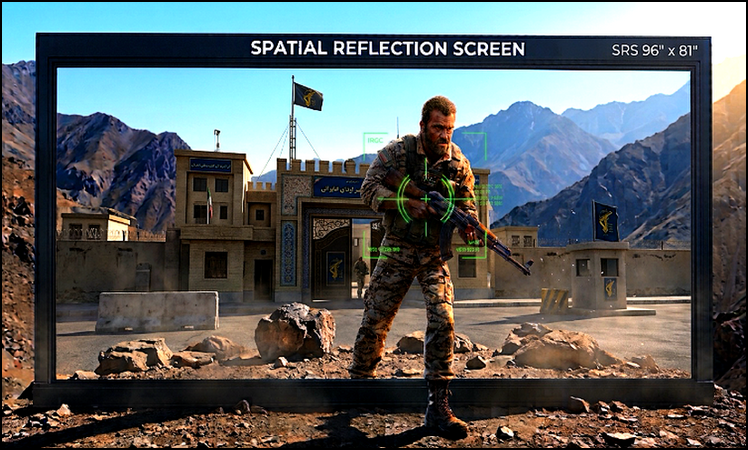
The technology is so precise, and the optical geometry so seamless, that the human brain’s visual cortex interprets the reflection as an authentic, continuous physical reality. When an operator trains within this specialized spatial application, the brain does not process the environment as a digital exercise. Instead, it triggers the survival axis—activating the sympathetic nervous system, accelerating the heart rate, and inducing the exact sensory conditions experienced during real-world lethal friction.
By establishing an undeniable biological trigger, the system forces the operator to perform under acute survival stress, optimizing close-quarters spatial awareness before deploying into an operational theater.
Micro-Scale Realism: Unscripted Reality and Live Ballistics
What sets the Troysgate experience completely apart from legacy training methods is its integration of unscripted human interactions, authentic equipment, and precise spatial methods.
- The Illusion of the Physical Breach: Because of the advanced optical engineering of the Spatial Reflection Screen, training scenarios possess an alarming depth of field. To the protector, it appears as though hostile role-players physically breach the threshold between the reflected environment and the enclosed room, moving seamlessly around physical boundaries.
- Live Equipment, Authentic Stakes: This is not a simulation game. Specialized role-players are armed with real firearms, and protecting operators deploy with their actual duty weapons, duty gear, and live ammunition.
- Eliminating Training Artifacts: Operating with real weapons in a ballistically safe, engineered micro-space forces the mind to discard administrative training habits (such as looking down at a holster or neglecting weapon indexing). The presence of live human actors executing unscripted, adaptive actions brings a level of raw realism into the training realm that must be experienced to be believed.
Recorded Scenarios and Troysgate Expert Analysis
Scenarios conducted in the enclosed, interactive environment are recorded for reviewand analysis by Troysgate experts. Rather than relying on automated tactical assessments, experts examine the recordings to assess participant actions, spatial awareness, and observable responses under stress across the following areas:
- Weapon Position and Spatial Awareness: Troysgate experts review scenario recordings to assess weapon handling, positioning, and awareness of the surrounding space, identifying observations for participant feedback.
- Movement and Scenario Review: Troysgate experts analyze recorded participant movement through the scenario, reviewing positioning, coordination, and decision-making to identify areas for improvement.
- Observable Stress Responses and Decision-Making: Troysgate experts examine the recordings for observable changes in reaction, perception, and behavior under stress. Their analysis informs a post-scenario debrief without treating video observations alone as biometric measurements.
Targeted Operational Solutions
Tier-1 Military Procurement: Subconscious Vulnerability Vetting
When evaluating elite personnel with years of combat experience, traditional stress tests fail. Seasoned operators can easily rely on conscious muscle memory and rehearsed tactical defaults to mask latent trauma, hyper-vigilance, or cognitive saturation loops. Procurement and selection units utilize the Spatial Reflection Screen to conduct a comprehensive subconscious vulnerability audit. By forcing the brain into a raw, unscripted psychological survival breach, the screen bypasses conscious conditioning to validate an operator's genuine cognitive resilience and spatial problem-solving before squadron assignment.
Law Enforcement Command Staff: Severe Liability Mitigation
For agency leadership, traditional training models present an institutional risk: officers are often exposed to their first true survival-state engagement in an unvetted, high-liability public setting. The Troysgate system resolves this by providing an auditable human performance data trail. It isolates critical human factor failure loops—such as neuro-perceptual reaction lag, weapon indexing discipline, and stress-induced visual misinterpretations—before they result in catastrophic field errors, excessive force litigation, or department-wide liability.
Frequently Asked Questions
How can real weapons and live ammunition be used safely in this environment?
Safety is achieved through rigorous engineering and structural isolation. The Troysgate System is deployed within an explicitly structured facility utilizing a multi-layered ballistic containment system. Specialized role-players, instructors, and operators are structurally segregated by advanced, blast-resistant shielding and specific line-of-sight geometry. This layout ensures that while the visual, auditory, and psychological experience feels entirely unified and seamless, the physical paths of live ballistics are completely controlled, contained, and isolated within engineered containment backdrops.
Why use live weapons and ammunition instead of non-lethal marking cartridges (Simunition) or laser systems?
The human brain is an extraordinary pattern-recognition machine. At a subconscious level, the brain easily identifies the reduced weight, different recoil profile, lack of acoustic concussive force, and administrative safety cues associated with training weapons or lasers. This awareness prevents the brain from triggering a true biological survival override. Using an operator's actual duty weapon, authentic duty gear weights, and live ballistic concussion removes these artificial "training artifacts," guaranteeing the brain fully buys into the threat reality and builds stress-resistant muscle defaults.
Does the system require operators to wear virtual reality headsets or specialized haptic clothing?
No. Virtual reality headsets, heavy spatial overlays, and haptic suits introduce synthetic limitations, visual latency, and awkward tethering that do not exist in the field. The Spatial Reflection Screen achieves its realism purely through advanced physical optics and spatial geometry. Operators enter the training space wearing only their standard operational uniforms and duty gear. There is zero technological latency; you see your environment, your weapon, and the threat with completely unobstructed, natural human vision.
Secure Your Operational Edge
Do not let your operators face their first true survival crucible in an unvetted, real-world deployment.
The Troysgate Spatial Reflection Screen bridges the gap between training expenditure and institutional survival, optimizing human performance when milliseconds matter most. Protect your assets, preserve your leadership capital, and validate your team's tactical dominance.
Schedule a Command Briefing & Institutional Demonstration
Contact us today to schedule a command briefing and coordinate a live-action command staff demonstration.